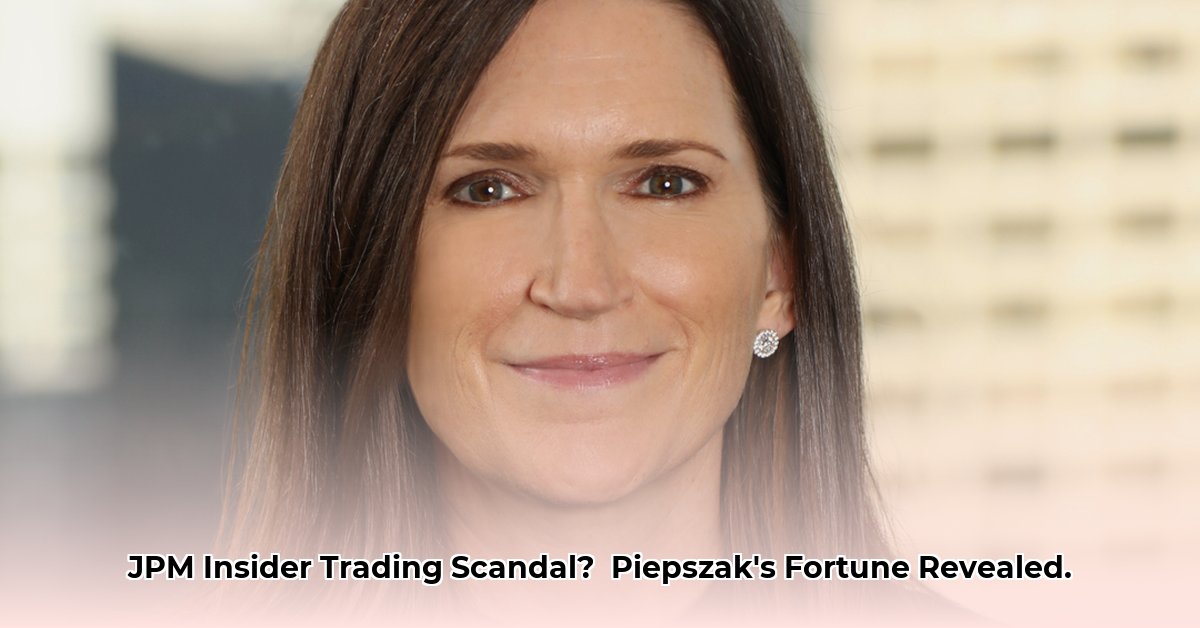
Jennifer Piepszak's Estimated Net Worth and the Context of JPMorgan Chase Insider Trading
Jennifer Piepszak, JPMorgan Chase's Chief Financial Officer, possesses an estimated net worth of approximately $20.4 million. However, recent insider trading activity at JPMorgan Chase, involving significant share sales by numerous executives, has prompted scrutiny and speculation. Understanding Piepszak's net worth within this context requires a careful analysis of the available data and a consideration of various factors that influence investment decisions. This analysis aims to provide a balanced perspective, highlighting both the potential significance of the reported activity and the inherent limitations of interpreting such information.
Analyzing the Significance of JPMorgan Chase Insider Trading
Since 2021, over 2.6 million JPMorgan Chase shares have been sold by insiders, compared to a mere 375 shares purchased. This striking imbalance has raised concerns among investors. Is this a sign of impending financial difficulties at JPMorgan Chase, or are there other explanations? It's crucial to avoid jumping to conclusions.
While the sheer volume of sales raises eyebrows, attributing these transactions solely to negative expectations about the company's future is an oversimplification. Several factors could be at play. Insiders might be diversifying their portfolios, addressing personal financial needs, or managing tax implications. The decision to sell shares is complex and depends on individual circumstances. For example, Troy Rohrbaugh's sale of 25,000 shares might be unrelated to any negative outlook on the company's future performance.
How does this affect the average investor? The high volume of insider sales introduces an element of uncertainty, making it more difficult to predict future stock performance for JPMorgan Chase.
Impact on Key Stakeholders
The high volume of insider stock sales at JPMorgan Chase has implications for a range of stakeholders:
| Stakeholder | Short-Term Impact | Long-Term Implications |
|---|---|---|
| Individual Investors | Increased uncertainty; potential for market volatility. | Requires a re-evaluation of JPM's long-term prospects. |
| Institutional Investors | Re-assessment of investment strategies; potential adjustments. | In-depth analysis of JPM's financial health and future plans. |
| Financial Analysts | Intense scrutiny of insider trading patterns; impact assessments. | Comprehensive forecasting incorporating multiple factors. |
| Regulatory Bodies (e.g., SEC) | Enhanced monitoring of JPM's activities; potential investigations. | Strengthened regulatory oversight and transparency requirements. |
Risk Assessment for JPMorgan Chase Investors
Investing in any company carries inherent risks. The recent insider trading activity adds another layer of complexity for JPMorgan Chase investors:
| Risk Factor | Likelihood | Potential Impact | Mitigation Strategies |
|---|---|---|---|
| Negative Market Sentiment | Moderately Likely | Potentially High | Diversification, hedging strategies |
| Regulatory Scrutiny | Moderately Likely | Moderate | Transparency, compliance with regulations |
| Misinterpretation of Trades | Very Likely | Moderate | Comprehensive analysis, consideration of market context |
| Economic Downturn | Moderately Likely | Potentially High | Risk management, diversified portfolio |
Interpreting JPMorgan Chase Insider Trading for Informed Investment Decisions
Understanding insider trading requires a structured approach:
Data Collection: Utilize reliable sources like the SEC's EDGAR database (https://www.sec.gov/edgar/searchedgar/companysearch.html) and reputable financial news outlets.
Identifying Key Players: Focus on C-suite executives and major shareholders whose transactions hold more weight.
Analyzing Transaction Patterns: Examine frequency, volume, and price changes. A sudden surge in sales might (but doesn't necessarily) indicate negative expectations, while significant purchases might suggest investor confidence.
Considering Timing: Trades close to announcements (earnings reports) are particularly noteworthy and should be investigated.
Contextualizing Information: Consider broader market trends and company-specific news.
Cross-Referencing Sources: Verify information from multiple sources to minimize bias and confirm accuracy.
Important Note: Insider trading activity is just one factor influencing investment decisions. It should be interpreted carefully and in conjunction with other relevant market data and analysis. Seeking guidance from a qualified financial advisor is always recommended.